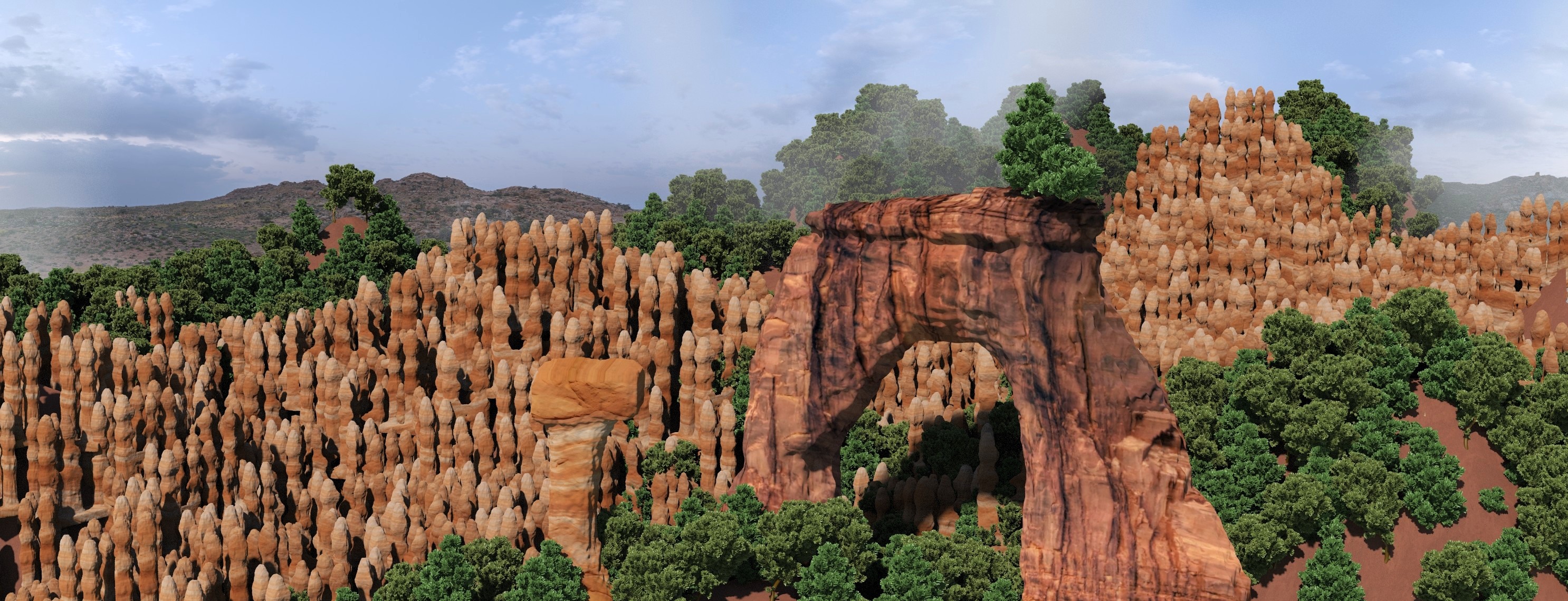
We introduce Arenite, a novel physics-based approach for modeling sandstone structures. The key insight of our work is that simulating a combination of stress and multi-factor erosion enables the generation of a wide variety of sandstone structures observed in nature. We isolate the key shape-forming phenomena: multi-physics fabric interlocking, wind and fluvial erosion, and particle-based deposition processes. Complex 3D structures such as arches, alcoves, hoodoos, or buttes can be achieved by creating simple 3D structures with user-painted erodable areas and vegetation and running the simulation. We demonstrate the algorithm on a wide variety of structures, and our GPU-based implementation achieves the simulation in less than 5 minutes on a desktop computer for our most complex example.
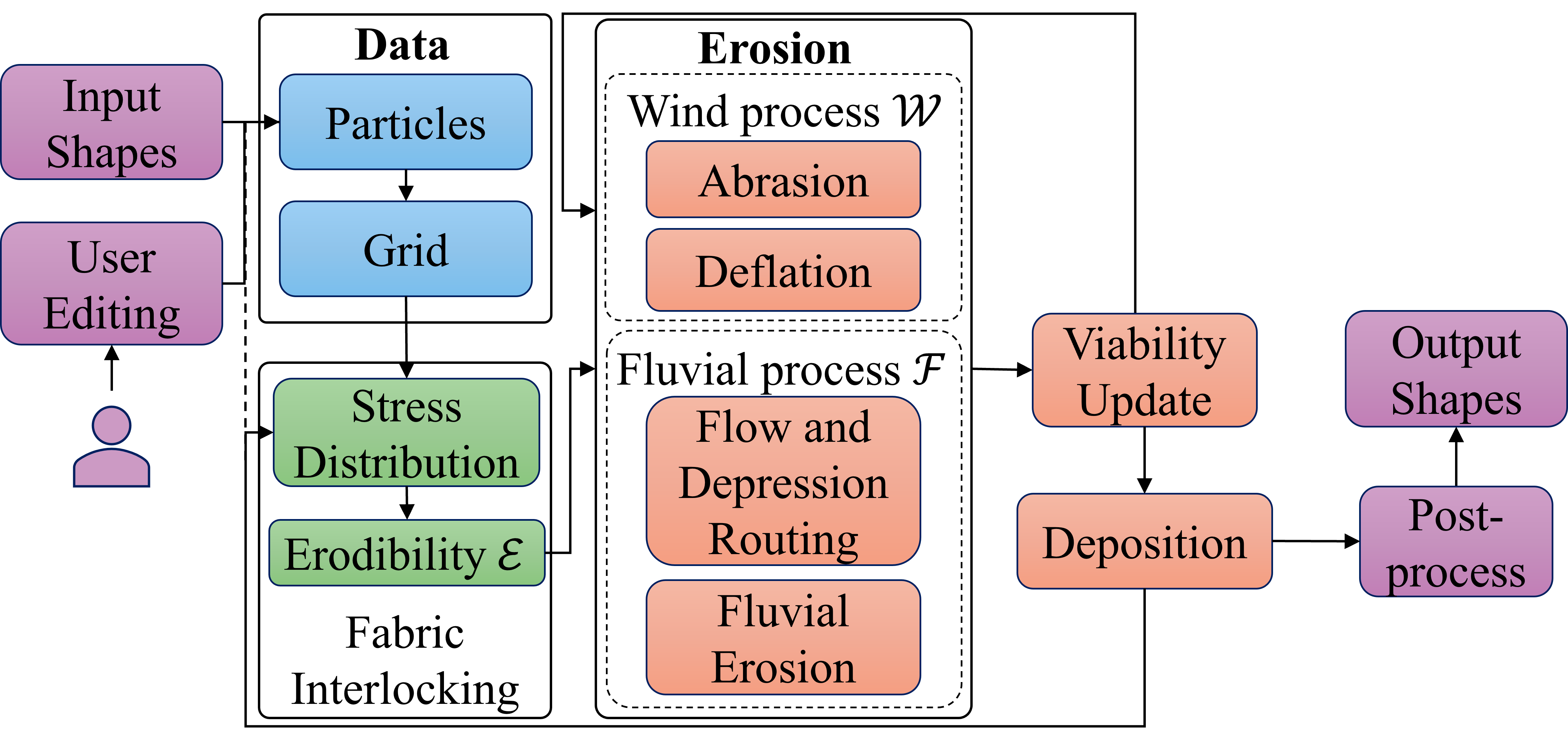
Arenite overview: The rough input shape has some areas painted by the user (viability, vegetation) and is converted into particles in a grid. Stress distribution is calculated, and erodibility is determined. The wind and fluvial erosion then modify the shape, and some material is deposited, which results in the final shape.






@article{10.1145/3731201,
author = {Yang, Zhanyu and Jain, Aryamaan and Cordonnier, Guillaume and Cani, Marie-Paule and Wang, Zhaopeng and Benes, Bedrich},
title = {Arenite: A Physics-based Sandstone Simulator},
year = {2025},
issue_date = {August 2025},
publisher = {Association for Computing Machinery},
address = {New York, NY, USA},
volume = {44},
number = {4},
issn = {0730-0301},
url = {https://doi.org/10.1145/3731201},
doi = {10.1145/3731201},
abstract = {We introduce Arenite, a novel physics-based approach for modeling sandstone structures. The key insight of our work is that simulating a combination of stress and multi-factor erosion enables the generation of a wide variety of sandstone structures observed in nature. We isolate the key shape-forming phenomena: multi-physics fabric interlocking, wind and fluvial erosion, and particle-based deposition processes. Complex 3D structures such as arches, alcoves, hoodoos, or buttes can be achieved by creating simple 3D structures with user-painted erodable areas and vegetation and running the simulation. We demonstrate the algorithm on a wide variety of structures, and our GPU-based implementation achieves the simulation in less than 5 minutes on a desktop computer for our most complex example.},
journal = {ACM Trans. Graph.},
month = jul,
articleno = {151},
numpages = {13},
keywords = {physical simulation of natural phenomena}
}